Does Your Dubai Business Need an llms.txt File? A Plain-English Guide for 2026-27
 06 Aug 2026
Table of Contents
- The Shift from Searching to Answering: Why 2026 Is the Year of the AI Agent
- What Exactly Is an llms.txt File?
- The Business Case: Why Your Dubai Brand Can't Afford to Be "Hallucinated"
- The Strategic Decision Matrix: Does Your Business Actually Need One?
- How to Create and Structure Your llms.txt File
- Content Engineering: Writing Summaries That AI Models Love
- Platform-Specific Implementation for Dubai Marketing Teams
- Measuring Success: How to Verify Your AI Search Visibility
- Future-Proofing for the Era of Agentic Retrieval
- Securing Your Place in Dubai's AI-Driven Future
- Frequently Asked Questions
TL;DR: An llms.txt file is a structured Markdown document placed at your website's root that tells large language models (LLMs) like ChatGPT, Gemini, and Perplexity what your business does and which pages to prioritize. For Dubai businesses competing in AI-powered search, implementing one is fast becoming a foundational step in any serious AI search optimization strategy.
The way people find businesses in Dubai has changed dramatically—and fast. Buyers, investors, and service seekers are skipping traditional Google searches and asking AI tools direct questions instead. "Which real estate agency is most trusted in Dubai Marina?" "What's the best legal firm for business setup in the UAE?" These conversational queries are now being answered by AI systems, not blue links.
That shift has created a brand-new problem: if your website isn't structured for AI crawlers, your business might not appear in those answers at all—or worse, it might be misrepresented. This is where the llms.txt file comes in.
This guide breaks down exactly what an llms.txt file is, why it matters for AI search optimization in Dubai, and how to implement one strategically for your specific industry. Whether you run a luxury hotel in Downtown Dubai, a legal consultancy in DIFC, or an e-commerce brand shipping across the UAE, the information here is designed to be practical, clear, and immediately actionable.
Why Dubai's digital landscape is moving faster than most global markets
From cashless payments to smart government services, Dubai has always been a forerunner of technology. Meanwhile, the UAE's National AI Strategy 2031 was launched by the government to leverage artificial intelligence to make it a world leader in the AI space - this has accelerated digital transformation across all layers. Businesses in the UAE have a massive real pressure to cope, and nowadays it is not just Google rankings but AI-generated answers that make you visible digitally.
Consumer behavior data supports this. According to a 2024 report by Statista, AI assistant usage in the MENA region grew by over 40% year-on-year, with the UAE leading adoption rates. That growth translates directly into missed opportunities for brands that haven't optimized for AI discovery.
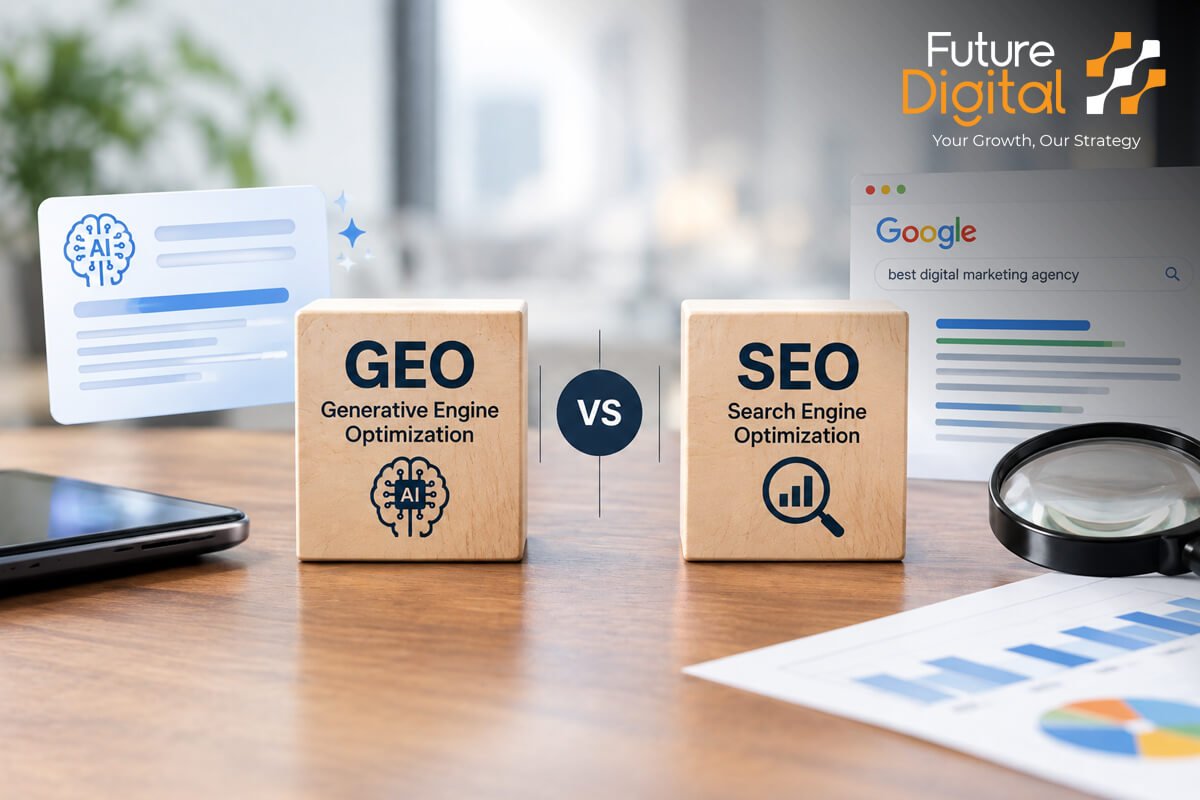
How does traditional Google search differ from Generative Engine Optimization (GEO)?
Traditional SEO agencies focus on getting your webpages to rank inside SERPs (search engine results pages) based upon a specific set of keywords, a website's backlink authority, and technical site health. Conversely, Generative Engine Optimization (GEO) optimizes your content to be findable and citeable by answer-generating AI systems—the kind that never send users to a results page.
The mechanics themselves are uniquely different, which is why GEO services in Dubai are becoming their own discipline. The way Googlebot crawls the web is fundamentally different from how AI models work. They pull up indexed structured information and piece it together into conversational responses. And if your content isn't prepared for that retrieval workflow, out it goes.
What is the role of AI-powered agents in UAE commerce and real estate?
AI agents are autonomous systems that perform tasks like researching, comparing, and booking on behalf of the human user, and they have begun to change our transactional behaviour in the UAE. These include AI agents pulling live business data just like a stock, like for real estate platforms, or workflow tools that help in travel planning or even legal research assistants. Brands that feed those agents with accurate, structured information — files like LLMs. Making sure that your txt stumbles into a little keyword commenting will have an artificially recognition on AI search visibility.
What Exactly Is an llms.txt File?
How does an llms.txt file communicate with large language models?
Think of llms.txt as a handshake between your website and AI systems. Placed at your domain root (e.g., yourdomain.ae/llms.txt), the file is written in Markdown and tells AI crawlers—including those operated by OpenAI, Anthropic, and Google—what your business does, which pages matter most, and how your content is organized.
This idea has been suggested by fast. AI founder Jeremy Howard in 2024, for a few days has gained powerful traction as the de facto standard for web-facing docs just focused on AI. It is not necessarily a ranking signal in classic SEO speak; it is a clarifying mechanism that mitigates the risk of misinterpretation.
How does llms.txt differ from robots.txt and sitemap.xml?
These three files serve completely different purposes. The robots. The txt file gives instructions to crawlers on which pages they should visit or not. The sitemap. xml file lists all your pages for discovery. The LLMs. A.txt file, on the other hand, is simply your website information summarized (in a human-readable way) so that AI systems can contextualize and value your content before they retrieve it.
| File | Purpose | Audience |
|---|---|---|
| robots.txt | Access control | All crawlers |
| sitemap.xml | Page discovery | Search engine bots |
| llms.txt | Content context & curation | Large language models |
What does a standard llms.txt file look like in practice?
A standard llms. Short business summary and a page list with short descriptions in the 2. That file is written in Markdown—headers, bullet points, and hyperlinks—all designating how the structure can be machine-readable. A companion file, llms-full. txt, is for a more complete deep indexing, and this is explained at the bottom.
The Business Case: Why Your Dubai Brand Can't Afford to Be "Hallucinated"
How do AI search engines like Perplexity, Gemini, and ChatGPT process local business data?
AI systems such as Perplexity AI, Google Gemini, and ChatGPT fetch data using either training data, live web crawling, or indexed structured sources. Q: What is the best accounting firm in Dubai's Business Bay? When a person asks a local question, these systems aggregate existing data into a response. But with unstructured websites, the AI is able to come up with vague or incorrect descriptions about your services, location, or expertise.
Similar situations, referred to in the technical context as hallucination, are an established problem with large language models. In high-stakes Dubai sectors — legal, financial, healthcare — a hallucinated claim about your firm's credentials or specialisations has the potential to viciously undermine your credibility and lose clients.
What is the citation uplift signal, and why does it matter for AI search visibility?
To the user, an answer an AI system produced is officially a high accountability (alongside its training data) based on your brand being recognized as a trusted source. Brands which appear in AI visually generated citations continue to compound an authority advantage through time. When your site clearly and accurately announces who you are, it produces a citation uplift effect much like ranking on page one of Google in the AI era.
Why should legal, health, and finance businesses in Dubai prioritize AI crawler optimization immediately?
The first, but not the last, group type on this list is the misrepresentation of AI in regulated industries. A Jumeirah healthcare clinic that is inaccurately classified by an AI tool, or a law firm whose website describes it as concentrating in a field outside its practice area, could be looking at potential reputational and compliance blowback. Implementing LLMs. When combined with schema markup and structured content, a simple.txt file is one of the most controllable ways to influence how AI will shape information about your brand.
The Strategic Decision Matrix: Does Your Business Actually Need One?
When should a Dubai business implement an llms.txt file?
That largely depends on how much content you have and your business model. The immediate beneficiaries are sites with high-value content, which could include legal guides, real estate investing blogs, medical knowledge pages, or education. These are the kinds of pages that AI systems go out and get to generate answers for complicated questions from users.
Landing pages with less unique content are a simpler task, but that will not give you results immediately. Of course, even a simple service provision will benefit from an llms. txt file that effectively relays its main abstract to AI crawlers.
Implement now if you:
- Operate in a high-trust industry (legal, finance, healthcare, real estate)
- Publish educational or in-depth content regularly
- Run a business where brand accuracy is mission-critical
- Compete in verticals where AI-generated answers are already prevalent
How should luxury retail and hospitality brands in Dubai use llms.txt as a brand protection tool?
And just as last-minute deals could be easier to access than the average deluxe brand in Dubai — five-star accommodation at Palm Jumeirah, for example, or expensive fashion items at Mall of the Emirates. txt doc actually double as a brand protector. Businesses can harness it to accurately articulate their positioning, value propositions, and service levels. This ensures that you don’t end up mixing premium brands with mid-market ones when the AI system is creating an answer to a recommendation.
How can e-commerce brands in Dubai use llms.txt as a conversion engine?
E-commerce teams can use llms.txt containing the top product category pages on their website, top sellers, and unique selling propositions. Dubai online retailers can influence the pages an AI system ranks as most relevant, helping to ensure that the answers generated by AI for shopping-related queries cite their particular products—bringing qualified and high-intent traffic straight to conversion pages.
How to Create and Structure Your llms.txt File
How should you write the core business summary for AI crawlers?
This is presumably for the opening summary of your LLMs. Ultimately, the txt file carries prime importance. It can be a short, factual description of who you are/what you do/who you serve. Limit this to 3-5 sentences maximum. Skip the marketing speak and jargon; AI systems flourish with straightforward declarative statements.
Example structure:
# Future Digital — SEO Agency in Dubai
> Future Digital is a Dubai-based digital marketing agency specializing in SEO, PPC, social media marketing, and AI search optimization for businesses across the UAE.
## Key Services
- [SEO Services in Dubai](https://futuredigital.ae/seo-agency-in-dubai): Full-service search engine optimization including technical SEO, local SEO, and AI website optimization. - [Social Media Marketing](https://futuredigital.ae/social-media-marketing-service-in-dubai): Platform-specific campaigns for brand growth and engagement.
How does Markdown formatting help guide AI discovery and retrieval workflows?
Markdown is the language of llms txt because they reflect the structural norms these LLMs were trained on at scale. Headers (##) create hierarchical signals. Bullet points group related items. Summaries are linked to source content through hyperlinks. And it enables AI crawlers to readily create an architecture map of your content without the requirement for parsing unstructured HTML.
What is the difference between llms.txt and llms-full.txt, and which one should your website use?
The llms. It serves as a summary index to your files that is meant for use by AI systems when retrieving information. The llms-full. TXT provides more: compound descriptions, total web page material summaries, and also bountiful metadata. If your site has translated structured data such as a UAE law firm with lots of knowledge base works or maybe a completed listing portal with hundreds of listings, you should implement both. LLMs can be used by smaller businesses as a starting point. txt summary file and grow them as their contents grow.
Content Engineering: Writing Summaries That AI Models Love
How should you prioritize high-value pages in your llms.txt descriptions?
No page should have equal value. Your llms. Consequently, the xls/txt file should start with your service pages, cornerstone content, and case studies. Each submission needs a link and a one- to two-sentence description that makes it clear what the page is about and who it is intended for. AI systems do not learn anything useful from vague descriptions like "learn more about our services."
How does schema markup support your llms.txt file for better AI search performance?
Schema markup and llms.txt are complementary, not competing. Schema, especially Organization and LocalBusiness and those few FAQPage and Article schema—provide HTML-level structured data signals to search engines or AI crawlers. The LLMs. The txt file provides a high-level narrative over that. Combined, they form a powerful, multi-signal system of record that amplifies your brand identity and expertise across every AI discovery channel.
How do you balance technical precision with brand positioning in AI-facing content?
This is where many businesses struggle. An llms.txt file written purely for technical accuracy can feel flat; one written purely for marketing can confuse AI retrieval systems. The solution is to lead with specific, verifiable facts—your industry, your location, your key services, your credentials—and then layer in positioning language that differentiates you from competitors. Think of it as a structured elevator pitch written for a machine.
Platform-Specific Implementation for Dubai Marketing Teams
How do Yoast SEO, Rank Math, and Shopify apps automate llms.txt generation?
Many popular CMS plugins are now launching automated LLMs.txt generation. Yoast SEO and Rank Math for WordPress have released modules that create LLMs. You will be creating txt files dynamically according to the structure of your existing content. Third-party apps generating product-based AI metadata are emerging for Shopify e-commerce stores in the UAE. These automated tools are a solid first pass, but it is advisable to verify results by hand.
How do you implement llms.txt manually for headless CMS or custom Webflow builds?
Headless CMS platforms—such as Contentful, Sanity, or custom Webflow builds—require manual llms.txt creation. The file is a plain-text Markdown document uploaded to your web server's root directory. For Webflow, this typically means placing the file through the CMS's asset management or custom code injection system. Once uploaded, verify accessibility by visiting yourdomain.ae/llms.txt directly in a browser.
How should API documentation and course description pages be integrated into llms.txt?
API docs for SaaS platforms, as well as course pages for online educators and training providers who operate in Dubai, are high-value, retrievable content within the growing digital economy. In your LLMs, you should clearly state these. You are given sample data up to October 2023, and a txt with well-defined descriptions of the contents of each resource. AI agents are leveraging structured documentation pages more often for research and learning, leading to this as a particularly high return area for AI website optimization.
Measuring Success: How to Verify Your AI Search Visibility
How can Dubai businesses use server logs to track AI crawler behavior?
When you view your web server logs, you will see that known AI bots have crawled the site as well: GPTBot (OpenAI), ClaudeBot (Anthropic), and Google-Extended (Google's AI training crawler). These logs will show whether your LLMs are monitored. This will enable you to monitor which of your txt files are being accessed and at what frequency. Cloudflare Analytics, AWStats, or even custom log parsing scripts can separate the AI bot traffic from that of typical crawlers.
What metrics indicate strong Answer Engine Optimization (AEO) performance?
AEO performance is measured differently from traditional SEO. Key indicators include:
- Brand citation rate: How often does your business appear in AI-generated answers for target queries?
- Answer accuracy: When cited, is your business described correctly?
- Referral traffic from AI platforms: Are you seeing traffic from Perplexity, ChatGPT, or Gemini?
- Featured snippet capture: Higher featured snippet rates often correlate with stronger AI answer inclusion
How do tools like Lighthouse and AI-based analysis platforms validate llms.txt implementation?
Google Lighthouse audits are technical performance signals (that affect AI crawler accessibility — page speed, validity of structured data, mobile-friendly optimization). Additional Tools to Validate: AI-Specific Validation Tools, including New-Generation Platforms like the LLMs Community tool to validate your txt and structured data testing. Google Rich Results Test confirms that you meet current standards. It is recommended to run these audits every quarter, as the specifications of AI crawlers evolve rapidly.
Future-Proofing for the Era of Agentic Retrieval
How should UAE businesses prepare for agent-to-agent workflows?
The evolution of AI search: User-to-AI Search is over —Agent—to—Agent Search is next level. In another year, autonomous AI systems are going to start querying other AI-driven business databases to perform microtasks such as sourcing suppliers, booking services for an event, or crafting a comparative report. Since you are reading this article, your UAE business will likely have the ability to be participants in these transactional AI workflows as they develop — with the condition of structuring their data for machine-readable retrieval today.
What does multi-search optimization look like for Dubai brands in 2026 and beyond?
Multisearch optimisation, the activity of optimising for Google, AI answer engines, voice search and agentic retrieval simultaneously, is now the new baseline for competitive digital marketing in Dubai. An llms. txt file is a part of a bigger organic AI search optimization in Dubai strategy that includes formulas for E-E-A-T content signals, schema markup, conversational keyword targeting & structured internal linking.
How does llms.txt support AI-driven transactions, not just AI-driven discovery?
Once AI agents go from research assistants to sales mediators—by being able to book meetings, ask for quotes, or make purchases on our behalf—the brands that have a clear identity (that is both human and machine-readable) are the ones that will get picked. Your LLMs. A txt file, thus, is a business ID document representing the AI economy in this sense. You want to get it right now as this will secure slick transactional visibility of your brand for years to come.
Securing Your Place in Dubai's AI-Driven Future
Discussions on AI in Dubai's business landscape have moved firmly beyond theory. ChatGPT is recommending—or ignoring—real estate developers. Perplexity is quoting—or misquoting— legal firms. Google AI Overviews Are Bringing Wellspring or Wasteland to Healthcare Providers. The LLMs and the infrastructure that is building all these outcomes are happening today. txt file is a core component of that architecture.
The good news? Implementing an llms. One of the most affordable actions a business in Dubai can take to improve its visibility on AI search engines is creating a txt file. No need to completely rebuild your website! It doesn't call for a huge rewrite. It demands precision, transparency, and the ability to be able to see your website from inside the minds of the AI systems that will increasingly serve as intermediaries between your brand and your customers.
If you're ready to move beyond traditional SEO and build a presence that's optimized for the AI-driven search landscape, the team at Future Digital specializes in exactly this. From technical implementation to full GEO services in Dubai, Future Digital builds AI-ready digital strategies for businesses across the UAE. Book a free consultation today and find out how AI search optimization in Dubai can turn your website into a trusted source for the tools your customers are already using.
FAQs
Frequently Asked Questions for Dubai Business Owners
Does implementing an llms.txt file replace my existing SEO strategy?
No. An llms.txt file complements your existing SEO strategy rather than replacing it. Traditional SEO practices—keyword optimization, technical site health, backlink building, and local SEO—remain essential for Google rankings. The llms.txt file adds a layer specifically designed for AI search visibility and AI crawler optimization. Think of it as extending your SEO strategy into the AI answer layer of search, not substituting one for the other.
Will an llms.txt file expose my private or sensitive business data?
Only if you reference it directly in the file. The llms.txt file should contain only the information you want AI systems and the public to access—your service descriptions, key page summaries, and business overview. It should never include internal pricing structures, client data, proprietary processes, or any information not already publicly available on your website. Review every URL you include in the file to confirm it is publicly accessible and intentionally public-facing.
How often should Dubai businesses update their llms.txt and llms-full.txt files?
Update your llms.txt file whenever there is a meaningful change to your business—new service lines, major content additions, rebranding, or changes to your core offerings. As a minimum, conduct a quarterly review to ensure all linked pages are still live and accurately described. AI crawlers revisit these files regularly, so keeping the information current is essential for maintaining accurate AI search visibility across platforms like ChatGPT, Gemini, and Perplexity.
Is an llms.txt file beneficial for small businesses in Dubai, or only large enterprises?
Both benefit, but for different reasons. Large enterprises with extensive content libraries use llms.txt to guide AI systems through complex site architectures and ensure high-priority pages receive attention. Small businesses benefit by establishing a clear, accurate brand identity for AI systems that might otherwise have limited data to draw from. For small business owners in Dubai with fewer online mentions and lower domain authority, an llms.txt file can disproportionately strengthen how AI platforms describe and recommend them.
What is the difference between AEO (Answer Engine Optimization) and GEO (Generative Engine Optimization)?
Answer Engine Optimization (AEO) focuses on structuring content so that it surfaces directly as an answer in search interfaces—including Google's AI Overviews, voice search results, and featured snippets. Generative Engine Optimization (GEO) is broader: it encompasses all efforts to make your content retrievable, citable, and accurately represented by generative AI systems like ChatGPT and Perplexity. In practice, the two disciplines overlap significantly. An llms.txt file supports both by giving AI systems a structured, authoritative source of information about your business.
Will AI search optimization in Dubai help my rankings in traditional Google search as well?
Yes, frequently. Many of the practices associated with AI search optimization—high-quality structured content, E-E-A-T signals, schema markup, and clear site architecture—are also rewarded by Google's traditional ranking algorithms. Google's own AI-powered systems, including the Search Generative Experience and AI Overviews, increasingly draw from the same quality signals. Investing in AI-focused optimization for Dubai audiences tends to produce compounding benefits across both AI and traditional search channels.
Which Dubai industries benefit most from implementing an llms.txt file right now?
Industries where accurate information is commercially and reputationally critical benefit most immediately. These include real estate (where buyer queries are highly specific and high-value), legal services (where credibility is non-negotiable), healthcare (where accuracy is a patient safety issue), financial services (where regulatory compliance matters), luxury hospitality (where brand positioning is everything), and e-commerce (where product discoverability drives revenue). That said, any Dubai business that relies on digital discovery stands to gain from improved AI search visibility.