 24 Jan 2026
Table of Contents
- Introduction: The End of an Era, The Dawn of a New Search Paradigm
- The Why: Fundamental Shifts in User Behavior and AI Search Engines
- Mastering AEO: Answer Engine Optimization for Direct Value
- Mastering GEO: Generative Engine Optimization for Discovery
- Mastering LLMO: Large Language Model Optimization for Engagement
- The Integrated Strategy: AEO, GEO, and LLMO as a Unified Approach
- Measuring Success in the AI-First World
- Your Action Plan for 2026: Preparing for the Future of Search
- Frequently Asked Question
Introduction: The End of an Era, The Dawn of a New Search Paradigm
For years, Search Engine Optimization (SEO) has been the cornerstone of digital visibility. We meticulously tracked keywords, built backlinks, and optimized meta tags to climb the search engine rankings. But the ground is shifting beneath our feet. The linear, link-based search we knew is being rapidly replaced by something more dynamic, conversational, and intelligent. The traditional SEO playbook is becoming obsolete.
From Keywords to Conversational AI: The Irreversible Shift
The way people seek information is changing. Instead of typing fragmented keywords into a search bar, users are now asking full questions and expecting direct, comprehensive answers. This shift is driven by the rise of sophisticated large language models (LLMs) and AI-powered search engines. These systems are designed to understand context, synthesize information from multiple sources, and present it directly to the user, often bypassing traditional blue links entirely.
Why SEO No Longer Captures the Full Picture of Digital Visibility
The term "SEO" is now too narrow. It fails to encompass the multifaceted approach required to be visible in an AI-first world. Optimization is no longer just about search engines; it's about optimizing for answers, for generative discovery, and for conversational engagement. Your content must be primed not just to rank, but to be understood, trusted, and utilized by AI models as a primary source of information. This requires a much deeper focus on structured data, entity understanding, and demonstrable authority.
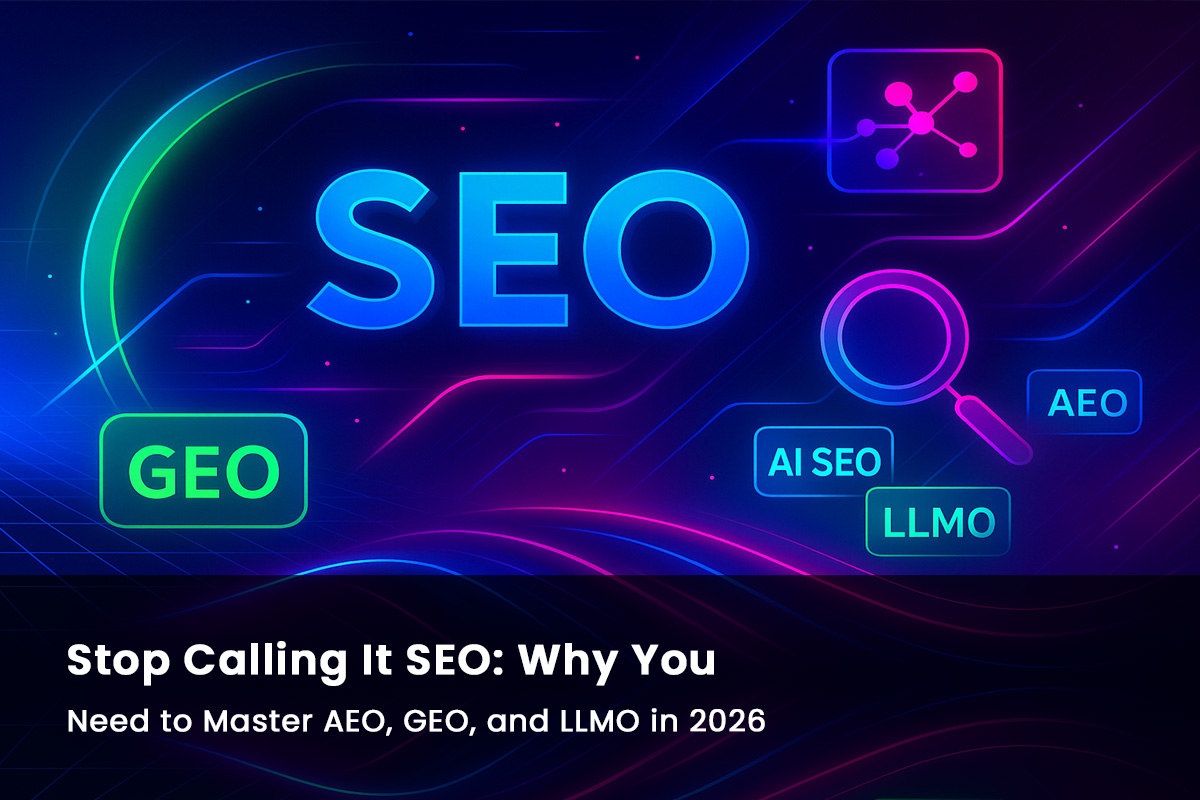
A Glimpse into the Future: Understanding AEO, GEO, and LLMO as Core Disciplines
To thrive in this new landscape, we must adopt a new framework: Artificial Intelligence Optimization (AIO). This holistic approach is built on three new core disciplines:
- Answer Engine Optimization (AEO): Optimizing content to be the direct source for AI-generated answers.
- Generative Engine Optimization (GEO): Optimizing for visibility within generative AI discovery and contextual recommendations.
- Large Language Model Optimization (LLMO): Optimizing content to be effectively used and referenced in conversational AI platforms.
Understanding the "AEO vs GEO vs LLMO" dynamic is no longer optional; it's the key to future-proofing your digital strategy.
The Why: Fundamental Shifts in User Behavior and AI Search Engines
The evolution of search is not just a technological change; it's a reflection of changing human behavior and expectations. Users have grown accustomed to immediacy and convenience, and their interaction with technology reflects this.
Users Demand Direct Answers and Synthesized Information
Patience for sifting through pages of search results is wearing thin. Today’s users want the answer, not a list of places to find it. They expect search engines to do the heavy lifting—to analyze, compare, and synthesize information into a single, cohesive response. This is precisely what features like Google AI Overviews are designed to deliver, transforming the user experience from a search journey to instant information delivery.
The Rise of AI Overviews and Conversational Search Engines
AI Overviews and similar features are becoming the new "position zero." They occupy the most valuable real estate on the results page, providing a summary answer compiled from various sources. If your content isn't structured to feed these AI-generated answers, your visibility will plummet, regardless of your traditional ranking. These new AI search functions prioritize content that is clear, factual, and easily digestible by an algorithm.
AI Models as the New Information Gatekeepers
In this new paradigm, AI models act as the primary information gatekeepers. They are the "research assistants" for billions of users. These models crawl the web, ingest content, and form their understanding of the world based on the data they process. Becoming a trusted source for these AI models is the new frontier of digital marketing. This means ensuring your content is not only high-quality but also machine-readable through tools like schema markup.
The Growing Importance of User Experience and Trust Signals in AI Search
AI systems are being trained to recognize and prioritize trustworthiness. They look for signals that indicate authority, expertise, and a positive user experience. This includes clear sourcing, author credentials, site security, and evidence of real-world expertise. Content that is accurate, well-supported, and provides genuine value will be rewarded. Conversely, content that is thin, inaccurate, or appears untrustworthy will be ignored or downranked by these intelligent systems.
Mastering AEO: Answer Engine Optimization for Direct Value
Answer Engine Optimization is the art and science of positioning your content as the definitive source for AI-generated answers. It's about being the solution, not just a suggestion.
What is AEO? Optimizing for AI-Generated Answers
AEO focuses on structuring your content so that an AI can easily extract a specific fact, definition, or step-by-step process to answer a user's query directly. Think of it as creating the perfect, citable snippet for an AI's research paper. This requires a shift from writing broad articles to creating precise, answer-first content modules that directly address specific questions.
Crafting Answer-First Content Architecture
To succeed at AEO, your content strategy must change. Instead of a single blog post on a broad topic, create a cluster of content where each piece answers a very specific question. Use clear headings, bulleted lists, and tables to break down information into easily digestible chunks. Front-load the answer in the first paragraph and use the rest of the content to provide supporting detail and context. This structure makes it simple for AI models to parse and pull your information for an AI Overview.
Building Authority and Trust: The "Proof" Element for AI
AI needs proof of your credibility. This is where trust signals become paramount. You can build this authority by:
- Implementing Schema Markup: Use structured data to explicitly tell AI what your content is about, who wrote it, and why it's credible.
- Citing Reputable Sources: Link to authoritative studies, data repositories, and expert organizations.
- Demonstrating Expertise: Showcase author credentials, case studies, and testimonials. The AI is learning to connect content with the real-world entities that produced it.
Mastering GEO: Generative Engine Optimization for Discovery
While AEO is about providing direct answers, Generative Engine Optimization (GEO) is about influencing the AI's contextual understanding to ensure your brand appears in broader, discovery-oriented results.
What is GEO? Optimizing for Generative AI Discovery and Contextual Relevance
GEO involves optimizing your entire digital presence to be understood within a wider context. It's less about specific keywords and more about the relationships between concepts, or what is known as entity understanding. When a user asks a generative AI for "the best options for a sustainable vacation," GEO ensures the AI understands your eco-lodge is a relevant and high-quality entity in the "sustainable travel" ecosystem.
Beyond Keywords: Embracing Natural Language Processing and Contextual Relevance
Forget keyword stuffing. Modern AI systems use natural language processing (NLP) to understand content the way a human does. They analyze sentence structure, sentiment, and the semantic relationship between words. Your content needs to be written naturally, covering a topic comprehensively and demonstrating a deep understanding of related subtopics. This helps the AI recognize your site as an authority on the subject.
Strategies for Generative AI Visibility
To improve your GEO, focus on building a rich knowledge ecosystem around your brand. This includes:
- Topical Authority: Create comprehensive content hubs that cover a subject from every angle.
- Entity Optimization: Ensure your brand, products, and key personnel are clearly defined and connected entities across the web (e.g., through structured data and knowledge panels).
- Contextual Interlinking: Build a strong internal linking structure that helps AI understand how your content pieces relate to one another.
Mastering LLMO: Large Language Model Optimization for Engagement
The final piece of the puzzle is Large Language Model Optimization (LLMO), which focuses on how your content performs within interactive, conversational AI environments.
What is LLMO? Optimizing Content for LLMs and Conversational Platforms
LLMO is about making your content "conversation-ready." As users increasingly interact with chatbots, voice assistants, and other conversational AI tools, your content needs to be formatted to fit this new medium. This means ensuring your information can be delivered in a clear, concise, and engaging conversational format.
Designing Content for Interactive AI Conversations
Content designed for LLMO is often modular. An AI might pull a single paragraph from one article, a list from another, and a definition from a third to construct a conversational response. Your job is to create these high-quality, independent "blocks" of information. This also involves anticipating follow-up questions and creating content that answers them, facilitating a deeper conversation.
The Nuance of Content Types: From Long-Form Articles to Micro-Responses
Your content creation strategy must diversify. While in-depth articles are still crucial for building authority (GEO), you also need to create micro-responses. This includes clear definitions, concise FAQs, and quick-reference data points. Each content type serves a different purpose in the AI ecosystem, from providing deep context to offering a quick, conversational reply.
Ensuring Accuracy and Preventing AI "Hallucinations"
A major challenge for LLMs is "hallucination," or generating incorrect information. By providing clear, factual, and well-sourced content, you not only increase your chances of being featured but also help improve the overall accuracy of the AI. Fact-check relentlessly and make it easy for the AI to verify your claims. This positions you as a reliable partner in the AI's mission to provide correct answers.
The Integrated Strategy: AEO, GEO, and LLMO as a Unified Approach
These three disciplines are not silos; they are interconnected components of a single, powerful strategy for Artificial Intelligence Optimization.
Building a Holistic "Artificial Intelligence Optimization" Framework
Your AIO framework should integrate all three practices. Use AEO to capture direct-answer queries. Use GEO to build the topical authority that makes the AI trust your answers. Use LLMO to ensure your answers are deliverable in a conversational format. This unified approach ensures you are visible at every stage of the new user journey.
The Symbiotic Relationship: How Each Discipline Enhances the Others
Strong GEO (authority) makes your AEO efforts (direct answers) more credible to the AI. Well-structured AEO content provides the perfect building blocks for LLMO (conversational responses). Effective LLMO engagement can, in turn, generate positive user signals that boost your overall authority (GEO). The success of one amplifies the others. The debate of AEO vs GEO vs LLMO is moot; they work in concert.
Evolving Your SEO Toolkit and Practices for 2026
Your traditional SEO toolkit needs an upgrade. Keyword research tools are still useful, but they must be supplemented with AI tools that help you identify user questions, analyze entity relationships, and generate structured data. The focus must shift from chasing rankings to building a robust, machine-readable knowledge base.
Measuring Success in the AI-First World
The old metrics are no longer sufficient. Pageviews and rankings don't tell the whole story when the answer is given directly on the results page.
Beyond Traditional Traffic and Rankings: New Metrics for Visibility and Impact
Success in the AIO world is measured differently. Key metrics now include:
- Share of "Answer": How often is your content featured in AI Overviews?
- Brand Mentions in AI Responses: Is your brand being recommended by generative AI?
- Quality of Traffic: Are the users who do click through more qualified and ready to convert?
Focusing on True Relevance, Quality, and User Satisfaction
Ultimately, the goal of both search engines and your business is to satisfy the user. The best way to optimize for AI is to create genuinely helpful, high-quality content that people love. AI systems are designed to identify and reward this. Focus on solving user problems, and the AI will recognize your value.
Leveraging AI Tools and Insights for Performance Analysis
New analytics platforms are emerging that are specifically designed to track visibility within AI environments. Use these AI tools to monitor your performance, identify opportunities, and understand how AI models are interpreting your content. This data-driven approach is essential for refining your AIO strategy.
Your Action Plan for 2026: Preparing for the Future of Search
The future of search is already here. Waiting is not an option. Here is how you can start preparing today.
Audit Your Existing Content for AI Readiness and Gaps in AEO, GEO, LLMO
Review your content library through the lens of AIO. Is it structured for direct answers (AEO)? Does it build topical authority (GEO)? Can it be broken down into conversational snippets (LLMO)? Identify your weaknesses and create a plan to update and optimize your most valuable content.
Invest in New Skills and Adopt AI Tools for Content Creation and Optimization
Your team needs to understand these new disciplines. Invest in training on structured data, entity optimization, and prompt engineering. Adopt AI tools that can assist with content creation, schema markup generation, and performance analysis to scale your efforts effectively.
Embrace Experimentation and Continuous Learning in a Rapidly Evolving Landscape
The world of AI is changing at an unprecedented pace. What works today may not work tomorrow. Foster a culture of experimentation. Test different content formats, analyze the results, and be prepared to pivot your strategy. Continuous learning is the only way to stay ahead.
Conclusion: The Future is Now – Are You Ready for Artificial Intelligence Optimization?
The conversation has moved beyond SEO. We are in the era of Artificial Intelligence Optimization, a more complex but ultimately more rewarding discipline. By mastering the integrated principles of AEO, GEO, and LLMO, you are not just optimizing for a machine; you are aligning your digital strategy with the future of human inquiry. Stop chasing keywords and start building knowledge. The AI is ready. Are you?
FAQs
FAQs – Digital Marketing Compliance in UAE 2026
What is the main difference between AEO, GEO, and LLMO?
AEO (Answer Engine Optimization) focuses on structuring your content to provide direct, specific answers for AI features like Google's AI Overviews. GEO (Generative Engine Optimization) is about building topical authority and context so your brand is recommended in broader, discovery-based generative AI results. LLMO (Large Language Model Optimization) involves adapting your content to be effective and engaging within conversational AI platforms like chatbots.
Why is traditional SEO no longer enough in 2026?
Traditional SEO, focused heavily on keywords and rankings, is insufficient because AI-powered search engines are changing how users get information. Instead of just showing a list of links, AI synthesizes direct answers and conversational responses. To be visible, you must optimize for these new formats, which requires a broader strategy than what traditional SEO covers.
How do AI Overviews change the optimization approach?
AI Overviews prioritize providing a single, summarized answer at the top of the search results. To appear in these summaries, your content must be highly structured, factual, and trustworthy. This shifts the focus from ranking #1 to being the primary source for the AI-generated answer, making structured data (like schema markup) and clear, answer-first content essential.
What is Artificial Intelligence Optimization (AIO)?
Artificial Intelligence Optimization (AIO) is a holistic framework that goes beyond traditional SEO. It integrates AEO, GEO, and LLMO into a unified strategy. The goal of AIO is to make your entire digital presence understandable, credible, and useful to AI systems, ensuring visibility across answer engines, generative platforms, and conversational interfaces.
How can I start preparing my content for AI search?
Begin by auditing your existing content. Identify opportunities to add structured data (schema markup), reformat articles into a question-and-answer style, and build out topic clusters to establish authority. Focus on creating high-quality, factually accurate content that directly addresses user questions and demonstrates expertise through clear sourcing and author credentials.
What are some key trust signals for AI models?
AI models look for signals that prove your content is credible and authoritative. Key trust signals include:
- Implementing detailed schema markup to define your content and authors.
- Citing reputable, external sources to support your claims.
- Building comprehensive content hubs that demonstrate deep expertise on a topic.
- Ensuring a positive user experience on your website.